The 7 principles of healthy homes are a framework developed to define what a home needs to truly support the health of the people living inside it. These principles cover everything from air quality and moisture control to safety, cleanliness, and pest management. For homeowners building or renovating a custom home, understanding these principles is the foundation of designing a space that actively improves daily life.
Most people spend serious thought on what goes into their bodies. The food they eat, the water they drink, the supplements they take. Far fewer stop to think about what their home is doing to their health every single day. The air inside a typical house, the moisture hiding in walls, the materials off-gassing chemicals into living spaces, all of these have a direct impact on how you feel, sleep, and function. The 7 principles of healthy homes offer a clear framework for understanding and solving these problems at the source.
Key Takeaways
- The 7 principles of healthy homes were developed to define what a home needs to support the physical health of its occupants.
- Indoor air quality is one of the most overlooked factors affecting daily wellness, sleep, and long-term health.
- Moisture control is critical — unmanaged humidity is the leading cause of mold growth, which degrades both the home and the health of people inside it.
- A truly healthy home is designed and built intentionally, not assembled from standard materials with wellness as an afterthought.
- Luxury custom home builders like Costner Building Group integrate these principles into every phase of design and construction.
- These principles apply to both new construction and whole-home renovations.
Things You Must Know
1. Most Homes Are Not Built With Health in Mind
Standard construction practices prioritize code compliance, cost efficiency, and aesthetics. Health outcomes are rarely part of the equation. That means most homes, even beautiful ones, can still harbor poor air quality, humidity imbalances, and materials that off-gas compounds into the air you breathe every day. Knowing this helps homeowners ask the right questions before building or renovating.
2. These Principles Work Together, Not in Isolation
You cannot fully achieve one principle without addressing the others. For example, a home that is kept dry but poorly ventilated will still have stale, polluted air. One that is well-ventilated but not properly maintained will reintroduce contaminants over time. The strength of a healthy home comes from treating these principles as a system, not a checklist.
3. The Building Phase Is the Best Time to Act
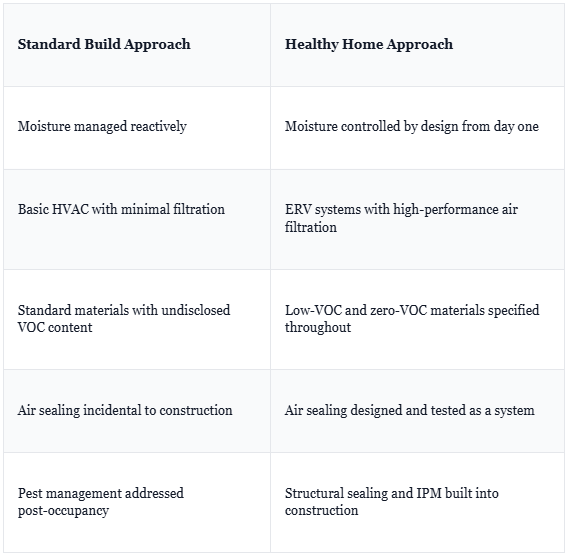
Retrofitting a home for health is far more difficult and expensive than building it correctly from the start. Many of the systems that most impact air quality, moisture, and thermal comfort are embedded inside walls and structures. If you are planning a custom home or major renovation, the decisions made during design and construction will shape your living environment for decades.
What Are the 7 Principles of Healthy Homes?
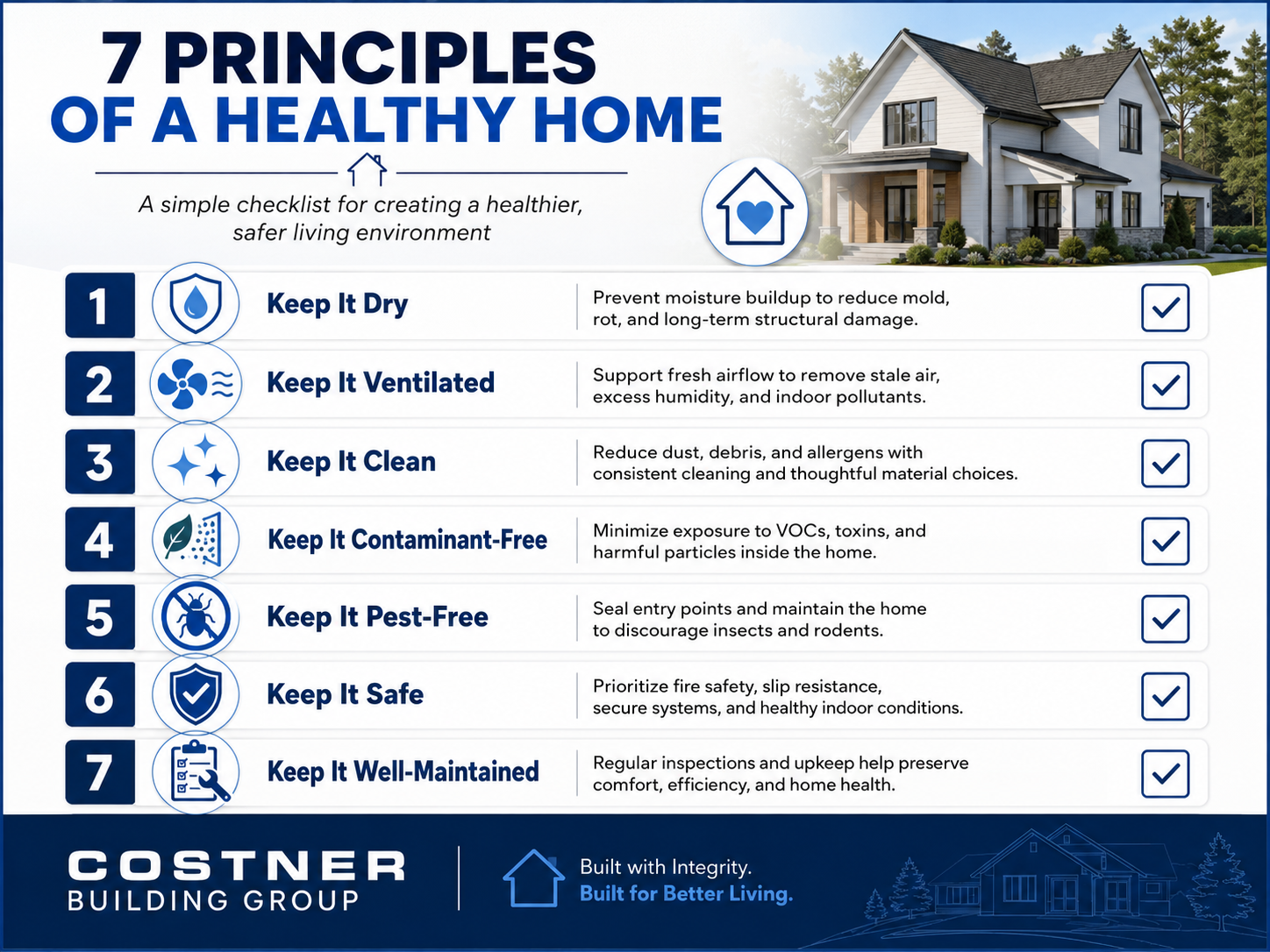
The 7 principles were developed by the U.S. Department of Housing and Urban Development and public health organizations to establish a shared standard for housing that supports human health. Each principle targets a specific risk area that research has consistently linked to illness, discomfort, or long-term harm.

Principle 1: Keep It Dry
Moisture is the single greatest threat to both a home's structure and the health of the people living in it. When moisture accumulates in walls, crawl spaces, or behind finishes, it creates the conditions that mold needs to grow. Mold spores circulate through the air and can trigger respiratory issues, allergies, and chronic inflammation, often without the homeowner even knowing the source.
Research consistently identifies moisture intrusion as the leading cause of indoor mold growth in residential homes, with crawl spaces and wall assemblies being the most common entry points.
In high-performance custom homes, moisture control goes far beyond gutters and waterproofing. It includes vapor barriers, properly managed crawl spaces, humidity-controlled mechanical systems, and building envelopes designed to prevent moisture from ever entering the wall assembly in the first place. This is where building healthier, higher-performance homes in Charlotte requires a fundamentally different approach than standard construction.
Principle 2: Keep It Ventilated
Most people assume the air inside their home is cleaner than outdoor air. The opposite is often true. Indoor air collects pollutants from building materials, cleaning products, cooking, furniture, and daily activity, and without adequate fresh air exchange, those pollutants concentrate over time.
The EPA has reported that indoor air can be two to five times more polluted than outdoor air, and in some cases significantly worse, particularly in tightly constructed homes without mechanical ventilation systems.
In a well-designed custom home, ventilation is handled by mechanical systems like Energy Recovery Ventilators (ERVs) that continuously replace stale indoor air with fresh filtered air from outside. This keeps pollutant concentrations low, supports better cognitive function, and creates a noticeably fresher living environment. Better air quality also improves sleep, which has a downstream effect on nearly every aspect of health.
Principle 3: Keep It Clean
A cleanable home is one that is designed to minimize the accumulation of dust, allergens, and pollutants, not just easy to wipe down. Hard flooring instead of carpet in key areas, smooth wall finishes, thoughtfully designed air filtration systems, and materials that do not collect or harbor allergens all contribute to this principle.
At the construction level, keeping a home clean also means specifying materials that do not shed particles, using low-VOC or zero-VOC finishes, and ensuring that HVAC systems include high-quality filtration. For homeowners dealing with allergies or asthma, these decisions can meaningfully change daily quality of life.
Principle 4: Keep It Contaminant-Free
This principle addresses chemical contaminants that can be invisible and odorless yet cause serious long-term harm. The most common include lead (in older homes), radon (a naturally occurring radioactive gas), carbon monoxide, and volatile organic compounds (VOCs) emitted by paints, adhesives, flooring, and furniture.
Radon is estimated to be the second leading cause of lung cancer in the United States, according to the EPA, yet the majority of homes are never tested for it.
In new custom construction, there is a genuine opportunity to get ahead of these risks. Specifying low-VOC materials throughout the home, incorporating radon mitigation systems during the build, and installing carbon monoxide detection as part of a broader home safety system all contribute to a contaminant-free living environment.
Principle 5: Keep It Pest-Free
Cockroaches, rodents, and dust mites are among the most potent allergen sources in residential homes. Beyond the obvious discomfort, pest activity leaves behind biological debris that circulates through the air and can trigger asthma attacks and allergic reactions. The key to managing this at the building level is Integrated Pest Management (IPM), which focuses on sealing entry points and eliminating conditions that attract pests rather than relying solely on pesticides after the fact.
Proper construction sealing, controlled moisture levels, and thoughtful landscaping choices all reduce pest pressure significantly. This is another area where a home built to high-performance standards outperforms a typical spec build over the long term.
Principle 6: Keep It Safe
Physical safety covers everything from fall prevention and fire safety to electrical hazards and structural integrity. In a luxury custom home context, this principle extends to thoughtful design decisions: stair configurations, lighting levels, slip-resistant surfaces in wet areas, and the use of durable materials that hold up without creating hazards over time.
Durability is itself a wellness feature. A home built with quality materials and proper construction techniques is less likely to develop structural issues, water intrusion, or material failures that create unsafe conditions years down the line. The whole-home remodeling approach in Charlotte that Costner Building Group uses prioritizes these long-term outcomes from the start.
Principle 7: Keep It Well-Maintained
A home can be built to the highest standard and still deteriorate quickly without the right maintenance practices. This principle acknowledges that health outcomes are not just a product of construction quality but of how the home is managed over time. HVAC filter replacements, moisture monitoring, regular inspections for early signs of water intrusion, and keeping ventilation systems clean all preserve the benefits that were built in from the start.
Deferred maintenance on HVAC systems and moisture intrusion points is widely cited in building science literature as one of the primary drivers of preventable indoor air quality problems in residential homes.
How These Principles Apply to Custom Home Construction
For homeowners planning a luxury custom build, these principles are most powerful when they are embedded into the design from the very beginning. Retrofitting a home for health after construction is possible, but it is always more expensive and less effective than building it right the first time.
Costner Building Group approaches every custom home as a health system, not just a structure. That means making deliberate decisions about the building envelope, mechanical ventilation, humidity control, material specifications, and moisture management at every stage of design and construction. Homeowners in the Charlotte area building custom homes or planning significant additions can explore how this approach applies to their specific project through Costner's high-performance luxury custom home building process.
Common Mistakes Homeowners Make When Building or Renovating
- Prioritizing aesthetics over air quality. Beautiful finishes lose their value quickly if the air inside the home is loaded with VOCs or allergens. Material specifications matter as much as design selections.
- Treating ventilation as optional. In a tightly sealed home, mechanical ventilation is not a luxury, it is a necessity. Without it, air quality degrades even in the most carefully built home.
- Ignoring crawl space conditions. Crawl spaces are one of the most common sources of moisture intrusion and mold in residential homes. They deserve far more attention than they typically receive during the planning phase.
- Choosing materials without checking for off-gassing. Many common building materials, including certain flooring types, adhesives, and insulation products, emit VOCs for months or years after installation.
- Skipping radon testing. Radon is present across many regions of the country and cannot be detected without testing. Integrating a radon mitigation rough-in during construction costs far less than installing one after the fact.
For homeowners thinking about expanding an existing home, many of these principles apply equally to additions. Costner's team brings the same building science focus to home additions in Charlotte as they do to full custom builds, ensuring that new spaces integrate seamlessly with the health performance of the existing structure. For those building near Lake Norman, the same principles guide Costner's approach to custom homes in the Lake Norman area, where humidity and moisture management require particular attention given the lakeside environment.
Frequently Asked Questions
Which principle is most important for asthma and allergy sufferers?
Ventilation and moisture control tend to have the greatest impact for people managing asthma or allergies. Poor ventilation allows allergens, dust, and irritants to accumulate in the air, while unmanaged moisture creates conditions for mold growth, which is one of the most common asthma triggers in residential environments. Homes with mechanical fresh air systems and robust humidity control provide a noticeably different breathing environment than standard builds.
How do I reduce household contaminants like lead and radon?
In new construction, the most effective approach is to build proactively. This means specifying low-VOC and zero-VOC materials throughout, installing a radon mitigation rough-in system during construction so it can be activated if testing shows elevated levels, and selecting finishes from manufacturers who provide transparent material disclosures. In older homes, professional testing for lead and radon is the recommended first step before any renovation work begins, as disturbing existing materials can release contaminants into the air.
What is Integrated Pest Management (IPM)?
Integrated Pest Management is a health-focused approach to pest control that prioritizes prevention over chemical treatment. In construction, IPM means sealing gaps and penetrations that allow pests to enter, managing moisture and food sources that attract them, and using targeted treatments only when necessary. Compared to routine pesticide application, IPM reduces chemical exposure inside the home and creates more durable, long-term protection against infestations.
How can a property be "well-maintained" when it comes to a home's health?
Maintenance for a healthy home goes beyond cosmetic upkeep. It includes replacing HVAC and ventilation filters on schedule, monitoring for early signs of moisture intrusion or mold, keeping gutters and drainage systems clear, servicing mechanical ventilation equipment annually, and periodically testing for radon if you haven't recently. Homes built with health in mind are generally easier to maintain because the systems are designed to be accessible and inspectable.
How are these principles relevant to renters versus homeowners?
Renters have less control over the building systems and construction quality of their home, but can still take steps to support several principles, including keeping the space clean, using air purifiers, monitoring for moisture or mold signs and reporting them promptly to landlords, and minimizing the introduction of high-VOC products. Homeowners and custom home builders have the greatest opportunity to apply all seven principles by design, which is why the custom build phase is the most powerful point of intervention for long-term health outcomes.
A Home That Works for Your Health
The 7 principles of healthy homes are not abstract ideals. They are practical, achievable standards that describe what a home looks like when it is genuinely designed around the health of the people living inside it. Clean air, controlled humidity, contaminant-free materials, proper ventilation, and thoughtful maintenance all add up to a living environment that supports your wellness rather than working against it.
For homeowners building a luxury custom home in Charlotte or the surrounding region, Costner Building Group brings this understanding to every project. The goal is not just a beautiful home. It's a home that makes you feel better every day you live in it.
Ready to explore what a health-focused custom home looks like in practice? Contact Costner Building Group to start a conversation about your project. Build Better, So You Can Live Better.

.jpg)