A house becomes unrepairable when the cost and scope of damage outweigh the structural and health value of keeping the existing building. The most common causes include catastrophic foundation failure, severe moisture infiltration leading to mold throughout the structure, irreversible rot, and compromised load-bearing systems. In many cases, the damage that makes a home unrepairable began long before it was visible.
Key Takeaways
- Foundation failure, widespread mold, severe structural rot, and compromised load-bearing systems are the most common reasons a home is deemed unrepairable.
- Many of the conditions that make a home unrepairable develop silently over years, hidden inside walls, crawl spaces, and subfloors.
- A home deemed unrepairable can still create serious health risks for anyone living inside it, even before demolition.
- Building a new high-performance home is often the safer, healthier, and more cost-effective path compared to attempting to repair a structurally compromised property.
- The quality of construction at the time a home was built plays a significant role in how quickly damage becomes irreversible.
Most homeowners never expect to hear that their home cannot be fixed. But for some properties, repair estimates stop making sense, structural systems stop being salvageable, and the building itself becomes more of a liability than an asset. Understanding what pushes a home past the point of repair helps you make better decisions, whether you're evaluating a property to purchase, assessing an older home, or trying to understand why a contractor is recommending demolition over renovation.
Things You Must Know
1. Damage That Is Invisible Often Causes the Most Destruction
The most serious causes of irreparable damage, such as moisture intrusion, mold colonies, and foundation movement, rarely announce themselves. By the time cracks appear in drywall or floors begin to feel soft, the underlying damage has often been progressing for years. A professional inspection that goes beyond the surface is almost always necessary to accurately determine how far the damage has spread.
2. Repair Cost Relative to Home Value Is a Key Threshold
There is no single legal definition of "unrepairable" for most residential properties, but lenders, insurers, and experienced builders typically apply a practical threshold: when the estimated repair cost approaches or exceeds 50 to 75 percent of the home's post-repair market value, the case for rebuilding becomes significantly stronger. This varies by region, property type, and severity, so a licensed structural engineer's assessment is essential before drawing any conclusions.
3. Living in a Severely Damaged Home Carries Real Health Risks
A home with advanced mold growth, structural instability, or deteriorated materials is not just an investment problem. It is a health environment problem. Mold spores, off-gassing from rotting materials, compromised ventilation, and pest infestations all degrade indoor air quality in ways that affect sleep, respiratory health, and daily wellbeing. This is not a theoretical risk. For families spending most of their time indoors, the quality of their home's structure and systems directly shapes the quality of the air they breathe every day.
What Are the Most Common Reasons a House Becomes Unrepairable?
Several distinct conditions can push a home beyond the point where repairs are practical. These conditions often compound each other, meaning one form of damage accelerates others throughout the structure.
Catastrophic Foundation Failure
The foundation is what everything else in a home depends on. When a foundation fails significantly, walls rack out of plumb, floors shift, door frames distort, and structural loads transfer in ways the framing was never designed to handle. Hairline cracks from normal settling are common and usually manageable. But large horizontal cracks in basement walls, significant vertical displacement, widespread spalling, or evidence of continuous movement over time can indicate a foundation that cannot be reliably restored.
Foundation repair can range widely in cost depending on the type of failure and the extent of work required. In cases involving full foundation replacement or underpinning across a large footprint, costs can exceed what is financially reasonable given the property's value and the additional remediation work often required on the floors and walls above.
Severe and Widespread Moisture Damage
Moisture is one of the most destructive forces in residential construction, and it operates slowly and silently. When a home has experienced long-term water intrusion through a failing roof, poor drainage, inadequate vapor barriers, or faulty plumbing, the damage spreads far beyond what is visible. Wood framing rots, subfloors deteriorate, and the conditions that support mold growth become embedded throughout the structure.
This is not just a building problem. As healthy homes are specifically designed to do, controlling moisture is one of the core functions of a well-built house. When moisture control has failed completely, the home's ability to provide a safe, healthy living environment has failed with it.
Extensive Mold Colonization
Surface mold can be treated. Mold that has grown into structural framing, penetrated wall cavities throughout multiple areas of the home, and been present long enough to degrade the wood itself is a different situation entirely. Remediation at that scale requires removing and replacing large portions of the structure, and even then, the guarantee that all mold has been eliminated is difficult to achieve without rebuilding those systems from scratch.
The EPA and numerous environmental health researchers have documented links between prolonged indoor mold exposure and respiratory symptoms, chronic inflammation, sleep disruption, and exacerbated asthma. For homeowners who already prioritize health and wellness, this category of damage should be treated with particular seriousness, regardless of the home's visual appeal or apparent structural integrity.
Irreversible Structural Rot
Wood rot that has progressed into load-bearing components such as sill plates, rim joists, main beams, or structural columns creates a condition where the home's skeleton is compromised. Replacing isolated sections is possible, but when rot has spread across interconnected systems, the scope of work required to restore structural integrity often means rebuilding the majority of the affected areas rather than repairing them.
Fire or Flood Damage at Scale
Significant fire damage affects not just the charred materials but also the structural integrity of anything exposed to intense heat. Steel connectors can weaken, engineered lumber can delaminate, and concrete can spall. Flood damage introduces not only moisture but also contaminants that embed in porous materials. When these events affect a large percentage of the structure, the cost and complexity of restoring the home to a livable condition, let alone a healthy one, can make demolition and rebuilding the only realistic path forward.
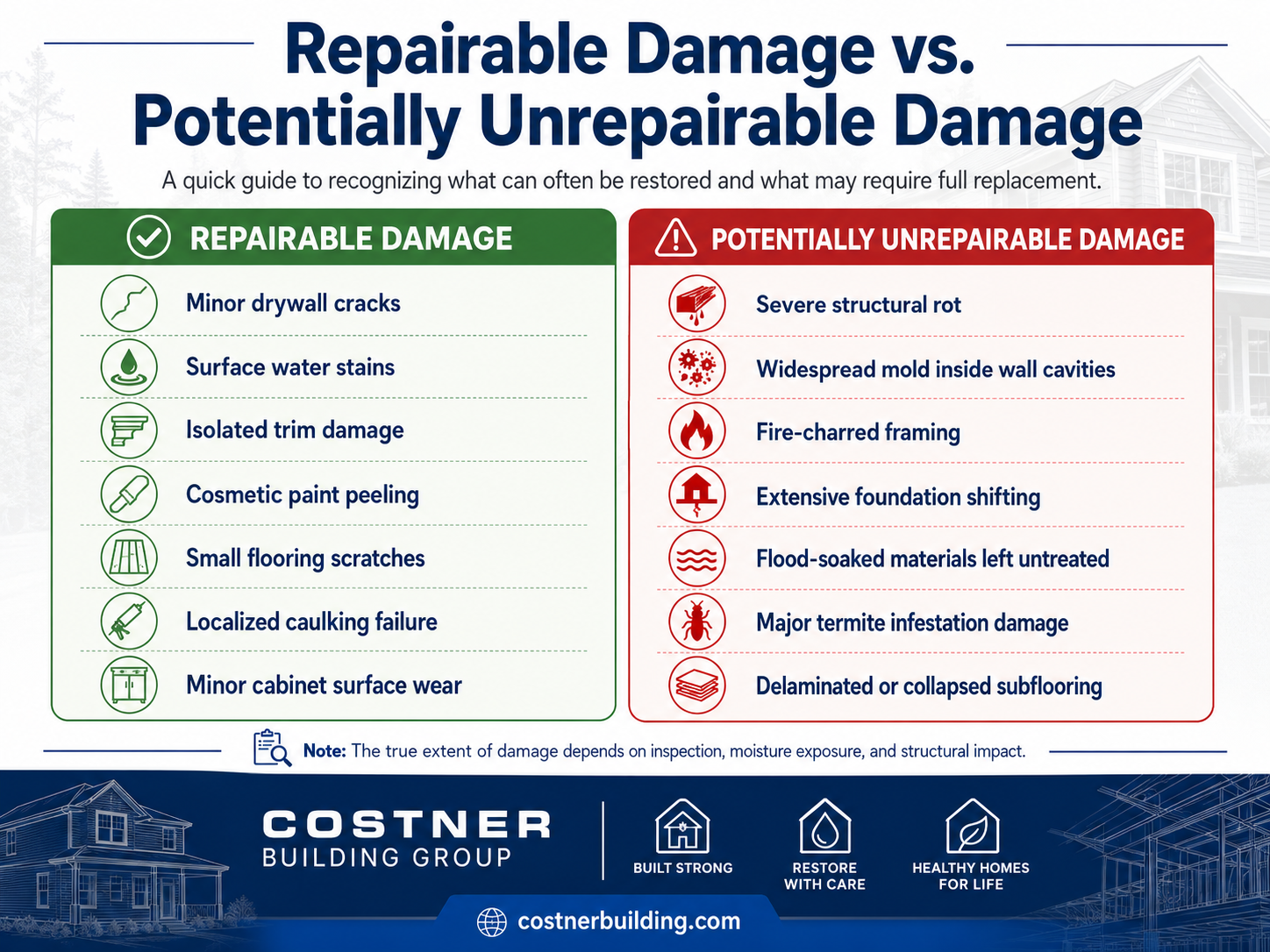
How Do You Know When Repair Crosses the Line Into Rebuild?
There is no single test, but there is a practical framework that experienced builders, engineers, and inspectors use to evaluate these situations.

What Role Does Original Construction Quality Play?
Homes built without attention to moisture management, air sealing, or proper ventilation tend to accumulate damage faster and more severely than those built with high-performance systems from the start. A home that lacks vapor barriers, has inadequate flashing details, relies on atmospheric combustion appliances in tight spaces, or was framed with materials that have poor moisture resistance will show signs of deterioration sooner, and that deterioration will spread further.
This is one of the reasons that understanding the principles of what makes a home healthy matters not just for wellness but for long-term durability. The same construction decisions that protect indoor air quality and reduce mold risk also extend the structural life of a home significantly. Durability and health are not separate goals. They are built from the same decisions.
Research in building science consistently shows that homes with proper moisture management systems, including continuous vapor barriers, balanced mechanical ventilation, and thermal bridging controls, experience significantly lower rates of structural deterioration over time compared to conventionally built homes of the same age.
Common Mistakes Homeowners Make When Assessing Severe Damage
- Relying only on visual inspection. The most serious damage is almost always hidden. A home that looks manageable on the surface may have extensive rot, mold, or structural compromise inside walls and under floors.
- Getting repair estimates before getting an engineering assessment. Contractors can tell you what it costs to fix what they can see. A structural engineer can tell you what is actually wrong, and those two things are often very different.
- Assuming cosmetic renovation will resolve underlying issues. New flooring over a rotting subfloor, fresh paint over mold, or updated finishes over a failing structure do not solve the actual problem. They delay recognizing it.
- Underestimating health impact while living in a damaged home. Families who continue occupying homes with significant mold or structural deterioration are often experiencing health effects they have not connected to their living environment.
- Overlooking the cumulative cost of phased repairs. Homeowners sometimes attempt to fix one system at a time, only to find that each repair reveals additional damage. The total cost of piecemeal repairs often exceeds what a full rebuild would have required.
When Building New Is the Right Answer
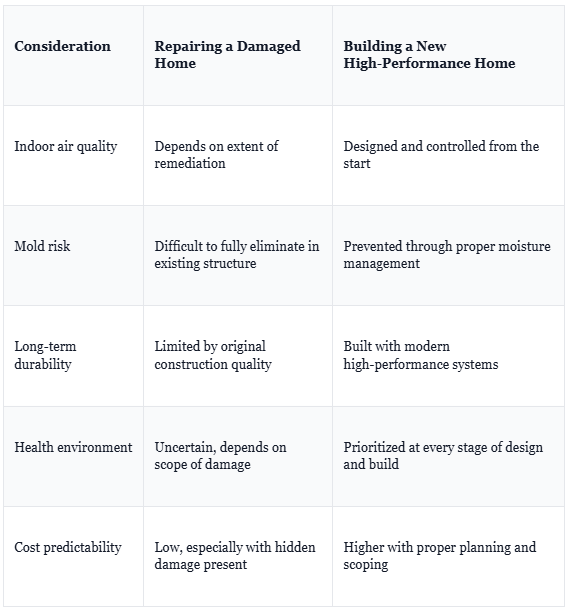
For homeowners who find themselves facing a property with irreparable conditions, building new provides something that renovation of a damaged structure can never fully offer: a clean starting point. A new home, built to modern high-performance standards, can be designed from the foundation up with systems that actively support health, comfort, and durability.
That means proper air sealing, balanced mechanical ventilation that continuously cycles fresh filtered air through the living space, humidity control that prevents the moisture accumulation that causes mold, and building materials selected for low off-gassing. These are not upgrades. They are foundational decisions that shape the quality of the environment the family lives in every day.
For homeowners in the Lake Norman area or Charlotte region considering this path, understanding what to expect when building a custom home in Lake Norman provides a clear picture of how that process works from the first conversation through move-in.
Understanding how high-performance custom homes in Charlotte are built for healthier living helps put into context what is actually possible when you start with the right systems rather than trying to retrofit them into a compromised structure.
Frequently Asked Questions
What does it mean when a house is officially "condemned"?
A condemned home is one that a local government authority has declared unfit for habitation, typically because the structure poses a safety risk to occupants or the public. Condemnation can result from severe structural failure, fire damage, health hazards such as extensive mold or contamination, or code violations serious enough to make the home uninhabitable. Condemnation does not automatically require demolition, but it does prohibit anyone from living in the property until the issues are resolved or the building is removed.
How can I tell if a wall crack is a cosmetic issue or a major structural failure?
Hairline cracks in drywall or plaster that run vertically and appear near corners of doors and windows are usually cosmetic, caused by normal settling or seasonal movement. Cracks that run diagonally at a 45-degree angle from corners, horizontal cracks in basement or foundation walls, or cracks that are wide enough to insert a coin into are more serious signals that require a professional evaluation. If a crack has grown over time or is accompanied by doors that no longer close properly or floors that have shifted, those are additional signs that a structural engineer should assess the situation.
Can a house with severe termite or pest damage always be saved?
Not always. Termite damage that has been present for many years can hollow out load-bearing framing to the point where the wood retains its shape but has little structural integrity remaining. In these cases, the cost of removing and replacing the compromised framing throughout the home can approach or exceed the cost of rebuilding. A pest inspection combined with a structural engineering assessment is the only reliable way to understand the true scope of termite damage, since much of it is not visible without opening walls and floors.
Will home insurance cover a house that is determined to be unrepairable?
This depends heavily on the cause of the damage and the specific policy terms. Insurance typically covers sudden and accidental events such as fire, storm damage, or burst pipes, but generally excludes damage from long-term neglect, gradual moisture intrusion, or pest infestation. If a home is deemed unrepairable due to conditions that developed over time rather than from a covered event, insurance may not provide significant coverage. Reviewing your policy carefully and consulting with a licensed insurance professional before drawing conclusions is the appropriate step.
Is it possible to sell a house if it is deemed unrepairable?
Yes, properties in severely damaged condition are sold, though typically at a significant discount and most often to buyers who intend to demolish and redevelop the land. Buyers in this category usually pay cash, and the transaction is based primarily on land value rather than the structure. If you are considering selling a property in this condition, a real estate professional with experience in distressed properties can help you understand what to expect in terms of pricing and buyer profile for your specific market.
What This Means for Families Who Want a Home That Lasts
The conditions that make a home unrepairable did not appear overnight. They developed through years of compromised construction, inadequate moisture management, and systems that were never designed to protect the structure or the people inside it. That is exactly why the decision to build right from the beginning matters so much.
Homes that are designed with proper moisture control, advanced ventilation, and durable materials do not just look better or feel more comfortable. They hold their structural integrity longer, require less intervention over time, and provide a living environment that actively supports health rather than quietly degrading it. As Costner Building Group approaches custom home building in Charlotte, every decision in the process connects back to one question: how does this choice affect the daily life of the family living inside this home?
If you are facing the question of whether an existing home can be saved, or if you are ready to build something designed to last and to support your family's wellbeing from day one, Costner Building Group is available to talk through your situation. Reach out to begin a conversation about what building better can look like for you.

.jpg)