Healthy homes do far more than provide shelter. They actively manage indoor air quality, control humidity, prevent mold, filter contaminants, and create an environment that supports better sleep, comfort, and long-term wellness. For homeowners building custom luxury homes, understanding what a healthy home actually does is the first step toward making decisions that improve everyday life.
Most people think carefully about the food they eat, the water they drink, and how often they exercise. Very few stop to think about the air inside their home, the moisture moving through their walls, or the invisible contaminants that can build up over time in a poorly constructed space. Your home is the environment you spend the most time in, and it has a direct impact on how you feel every single day.
Key Takeaways
- Healthy homes continuously manage indoor air quality through advanced ventilation and filtration systems, replacing stale air with fresh, filtered air throughout the day.
- Humidity control is one of the most overlooked features in home construction, and poor moisture management is the leading cause of mold, odors, and structural degradation.
- Common building materials and finishes can off-gas volatile organic compounds (VOCs) for months or years after construction, affecting the air quality inside the home.
- Healthy homes are designed with airtight construction that maintains consistent temperatures, reduces allergen infiltration, and supports more restful sleep.
- Contaminants like radon and lead are manageable with the right construction approach, but they require intentional planning from the beginning of the build.
- A high-performance home built for wellness is not a luxury upgrade. It is a foundational decision that affects your family's health for as long as you live there.
Things You Must Know
1. Most Standard Homes Are Not Built With Your Health in Mind
The majority of residential construction follows minimum building codes, which are designed to meet safety baselines, not optimize for wellness. Standard ventilation, insulation, and material choices are selected for cost efficiency and code compliance. Homeowners who want a home that actively supports their health need to be intentional about specifying high-performance systems from the design phase forward.
2. Indoor Air Quality Is Often Worse Than Outdoor Air
Studies have found that indoor air can contain significantly higher concentrations of certain pollutants than outdoor air, even in urban environments. This happens because modern homes trap air inside while also containing materials, furnishings, and cleaning products that continuously release chemicals. Without a proper ventilation strategy, those pollutants accumulate over time.
3. The Decisions Made During Construction Cannot Be Easily Fixed Later
Ventilation systems, vapor barriers, airtight envelopes, and moisture management details are built into the structure of the home. Retrofitting these systems after construction is either extremely expensive or simply not possible. Getting these decisions right during the build is far more effective than trying to correct them later through air purifiers or dehumidifiers alone.
What Does a Healthy Home Actually Do?
A healthy home is not a passive structure. It is an active system that manages the air you breathe, the moisture inside your walls, the temperature in every room, and the quality of the environment you live in day after day. When these systems work together correctly, the result is a home that feels noticeably different from a standard build.
People who move into high-performance homes frequently describe sleeping better, experiencing fewer allergy symptoms, and feeling more comfortable year-round without constantly adjusting thermostats or running air purifiers. These are not coincidences. They are the direct result of intentional construction decisions.
How Does a Healthy Home Manage Indoor Air Quality?
Indoor air quality is the foundation of a wellness-focused home. The air inside a standard home is a mixture of whatever comes in from outside, whatever off-gases from materials and furnishings inside, and whatever accumulates when there is not enough ventilation to dilute and remove those compounds.
The EPA has noted that indoor air pollutant levels can be two to five times higher than typical outdoor concentrations, and in some cases, significantly more. Common indoor sources include pressed wood furniture, carpeting, paint, adhesives, cleaning products, and combustion appliances.
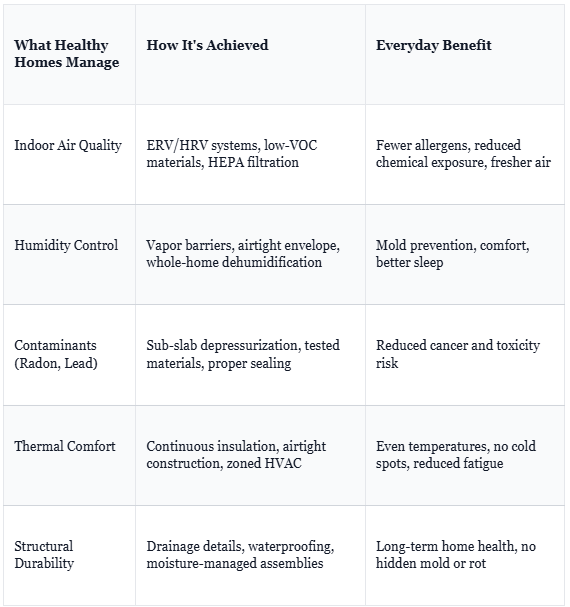
A healthy home addresses this in two ways. First, it uses low-VOC or zero-VOC materials throughout construction, from framing adhesives to paints and finishes, so that the home itself is not continuously releasing chemicals into the air. Second, it uses a mechanical ventilation system, typically an energy recovery ventilator (ERV) or heat recovery ventilator (HRV), that continuously replaces stale indoor air with fresh filtered air without creating uncomfortable drafts or losing conditioned air.
This approach to building healthier, higher-performance homes in Charlotte is central to how Costner Building Group designs every custom home. The goal is not just to meet ventilation minimums, but to create an environment where the air you breathe every day supports your health rather than undermining it.
What Role Does Humidity Control Play in a Healthy Home?
Humidity is one of the most consequential and least discussed variables in residential construction. Too much moisture in the air creates conditions where mold, dust mites, and bacteria can thrive. Too little moisture can cause dry skin, irritated airways, and discomfort. A healthy home maintains relative humidity within a range that is comfortable, clean, and safe.
The American Society of Heating, Refrigerating and Air-Conditioning Engineers (ASHRAE) generally recommends maintaining indoor relative humidity between 30% and 60% to minimize the growth of biological contaminants and reduce the risk of respiratory issues.
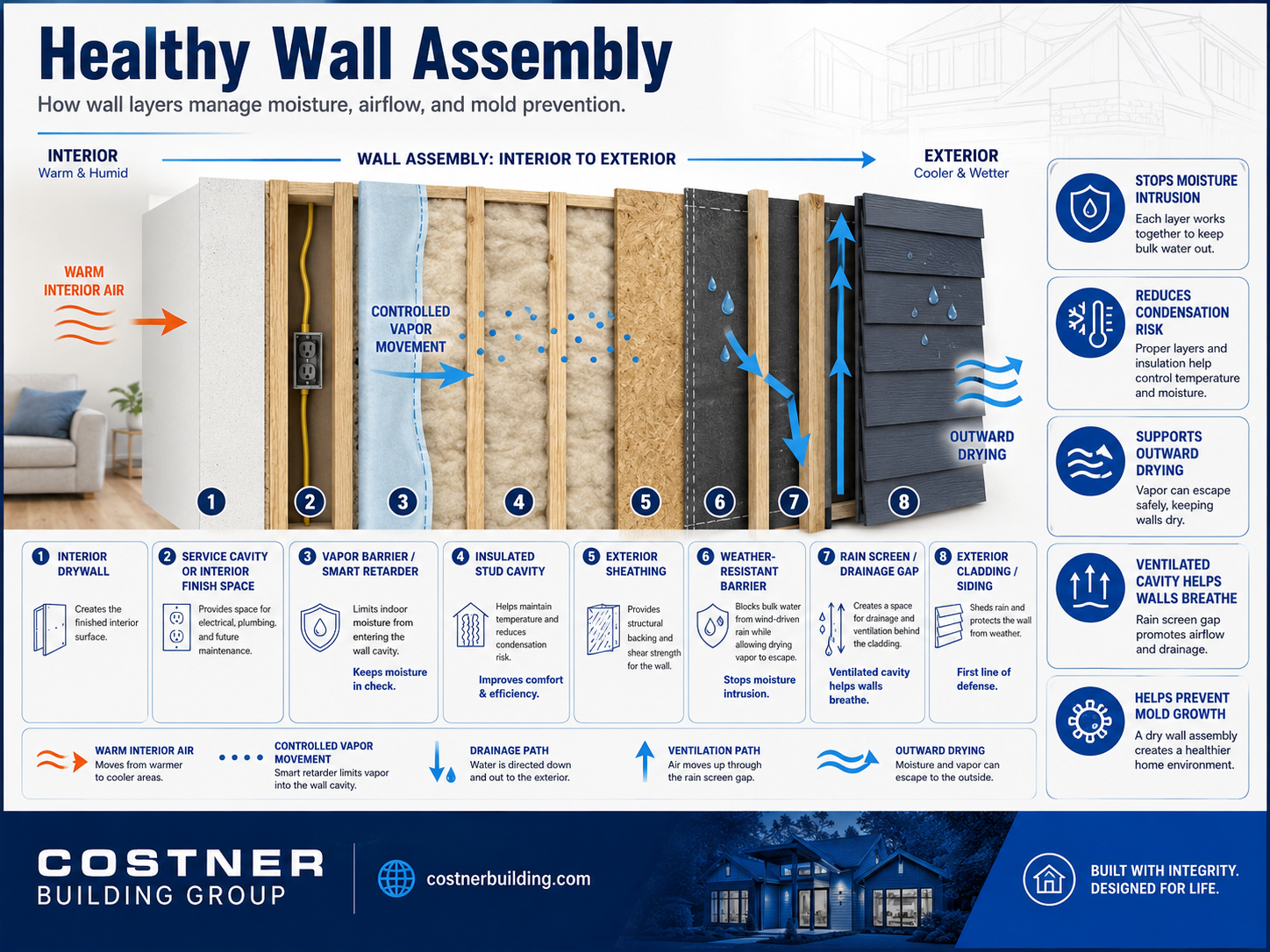
In a high-performance home, humidity control is built into the structure itself, not just managed by standalone appliances. Continuous air barriers, vapor retarders, and properly detailed building envelopes prevent moisture from migrating into wall cavities where it cannot be seen and where mold can grow undetected for years. The mechanical systems then work within a well-sealed structure to maintain stable humidity levels throughout the home.
How Does a Healthy Home Prevent Mold?
Mold requires three things to grow: a food source (organic material like wood or drywall), the right temperature, and moisture. A healthy home eliminates the third variable by controlling moisture at every stage of construction and occupancy.
This starts with how the home is built. Proper flashing, drainage planes, and waterproofing details keep bulk water out of the structure. Air barriers prevent humid air from reaching cold surfaces inside walls where it could condense. Mechanical systems manage interior humidity so that surfaces inside the home never become damp enough to support mold growth.
The connection between durability and wellness is real. When moisture gets into a building assembly and causes rot, mold, or structural damage, those problems eventually affect the air inside the home. Musty odors, elevated mold spore counts, and degraded indoor air quality are all downstream consequences of poor moisture management during construction. Learn more about the core principles that define a truly healthy home and how each one connects back to the way you feel every day.
How Healthy Homes Handle Contaminants Like Radon and Lead
Two of the most significant indoor contaminants in residential homes are radon and lead, and both are manageable when the right systems are in place from the start of construction.
Radon is a naturally occurring radioactive gas that enters homes through the foundation. It has no color, no odor, and no taste, which means it can accumulate in a home without any visible signs.
NEEDS CITATION
The EPA considers radon the second leading cause of lung cancer in the United States, responsible for an estimated 21,000 deaths annually. Sub-slab depressurization systems, which are most effectively installed during new construction, are the standard mitigation approach.
Lead is primarily a concern in older homes through existing paint and plumbing, but it can also be introduced through certain building materials if a builder is not selective about sourcing. A high-performance builder pays attention to what goes into the home at every level, not just the visible finishes.
Building a new custom home provides a rare opportunity to start clean, using materials that have been vetted for safety, with systems designed to prevent contaminant buildup from the first day of occupancy forward. For homeowners exploring a custom home build in Charlotte, this intentionality is baked into every phase of the Costner Building Group process.
What Makes a Home Truly Safe and Well-Maintained for the Long Term?
Safety in a healthy home extends beyond physical hazards. It includes the ongoing structural integrity of the building, the performance of its mechanical systems, and the ability of the home to continue providing a healthy environment years after it was built.
High-performance homes are designed with durability as a core value, not as an afterthought. When moisture is managed correctly, when materials are selected for longevity, and when building assemblies are detailed to resist the forces that degrade standard construction over time, the home continues to perform well across decades.

How Healthy Homes Support Better Sleep and Daily Comfort
The connection between your home environment and your sleep quality is more direct than most people realize. Consistent temperatures, cleaner air, controlled humidity, and reduced noise infiltration all contribute to an environment where the body can recover more effectively during sleep.
Research in environmental health consistently links elevated CO2 levels (a common consequence of poor ventilation), excess humidity, and temperature fluctuations to disrupted sleep patterns, increased fatigue, and reduced cognitive performance the following day.
In a high-performance home, the bedroom environment is stable. Temperatures do not fluctuate because the building envelope holds conditioned air without constant cycling. Air is continuously refreshed rather than recirculated. Humidity stays within a range that feels comfortable rather than clammy or dry. These conditions do not require conscious effort from the homeowner. They are built into how the home operates.
For families building near Lake Norman or across the greater Charlotte area, where humidity and seasonal temperature swings are real considerations, this kind of environmental stability is especially meaningful. Explore what to expect when building your dream home in Lake Norman and how site conditions factor into the design process.
Common Mistakes That Undermine a Healthy Home
- Skipping or under-sizing ventilation systems: Many builders install the minimum ventilation required by code, which is not designed to maintain indoor air quality in a tightly sealed modern home. Without adequate fresh air exchange, pollutants accumulate.
- Using standard building materials without checking VOC content: Adhesives, subfloor products, paints, and cabinetry can all off-gas chemicals for extended periods. Not all products are equal, and selection matters.
- Treating moisture management as a finishing step: Waterproofing details, drainage planes, and vapor control need to be addressed at every phase of construction. Catching moisture problems after framing is far more costly than designing for them from the start.
- Ignoring radon risk during new construction: Installing a passive radon mitigation system during construction costs a fraction of what it costs to retrofit. In many regions, radon testing after move-in reveals levels that require correction.
- Relying on portable air purifiers to compensate for poor ventilation: Air purifiers can help at a room level, but they do not address the root causes of indoor air quality problems. Whole-home ventilation strategy is the correct foundation.
What the Process of Building a Healthy Home Looks Like
- Design-phase specification: Ventilation strategy, material selections, moisture management details, and mechanical systems are planned before construction begins, not added as upgrades at the end.
- Airtight envelope construction: The building envelope is sealed and tested to confirm it performs at the level needed to support the ventilation and filtration systems being installed.
- Moisture management detailing: Every penetration, joint, and assembly is detailed to manage bulk water and vapor, protecting the structure and maintaining indoor air quality.
- Mechanical system integration: ERV or HRV systems, whole-home dehumidification, and advanced filtration are integrated into the HVAC design as a complete system rather than individual components.
- Material vetting: Finishes, adhesives, flooring, cabinetry, and other interior products are selected with low chemical emissions as a requirement, not an afterthought.
- Commissioning and testing: Before move-in, systems are tested and balanced to confirm the home is performing as designed and delivering the indoor environment it was built to provide.
If you are considering an addition or renovation rather than a full new build, many of these principles can still be applied. See how home additions in Charlotte can be approached with the same high-performance standards as new construction.
Frequently Asked Questions
What does it mean to "keep a home dry"?
Keeping a home dry means managing moisture at every level of the building assembly, from the foundation up through the roof. This includes preventing bulk water intrusion through proper flashing, waterproofing, and drainage, as well as controlling vapor movement through walls and ceilings with air barriers and vapor retarders. A dry home resists mold growth, protects structural materials from rot, and maintains healthier indoor air quality over time.
How do healthy homes ensure good indoor air quality?
Healthy homes use a combination of strategies: airtight construction that prevents uncontrolled air infiltration, mechanical ventilation systems (typically ERV or HRV) that continuously supply fresh filtered air, low-VOC material selections that reduce chemical off-gassing, and advanced filtration that removes particulates from the air supply. These systems work together rather than relying on any single product or fix.
What is done to keep a home pest-free in a high-performance build?
An airtight building envelope also significantly reduces pest entry points. When a home is properly sealed at the foundation, around windows and doors, and at every penetration through the building shell, the number of entry points for insects and rodents drops considerably. High-performance builders pay close attention to these details as part of the air sealing process, which serves multiple health and durability goals at once.
How are contaminants like lead and radon managed in a new custom home?
In new construction, radon is most effectively addressed through sub-slab depressurization systems that prevent radon gas from entering the living space through the foundation. These systems are far less expensive to install during construction than to retrofit later. Lead is primarily addressed through careful material selection, since new construction does not involve legacy lead paint or plumbing. A builder who vets materials for chemical safety will naturally avoid introducing lead-containing products into the build.
What makes a home "safe" in terms of long-term maintenance and wellness?
A safe, well-maintained home is one that was built with durability built into its systems and assemblies from the start. When moisture is managed correctly, when materials are selected for longevity, and when mechanical systems are properly sized and installed, the home continues to perform well without requiring constant intervention. The goal is a home that takes care of its occupants without the occupants having to constantly manage its systems.
Your Home Should Be Working for Your Health Every Day
A home is the environment you spend the most time in. The air you breathe there, the humidity levels in every room, the materials surrounding you, and the systems managing your comfort all have a real and measurable impact on how you feel, how well you sleep, and how your family's health holds up over time.
Most homeowners will never see the inside of their walls, never think about the air exchange rate in their home, and never consider whether the materials in their kitchen cabinets are off-gassing into their living space. A well-built healthy home takes those decisions off your plate by getting them right from the beginning.
At Costner Building Group, every custom home is built around one central idea: your home should support your health, not silently undermine it. If you are planning a custom home and want to understand what it means to build one that actively works for your wellness, explore how Costner builds high-performance luxury homes designed to help you live better from day one.
Ready to talk about what a healthy home could look like for your family? Contact Costner Building Group to start the conversation.

.jpg)